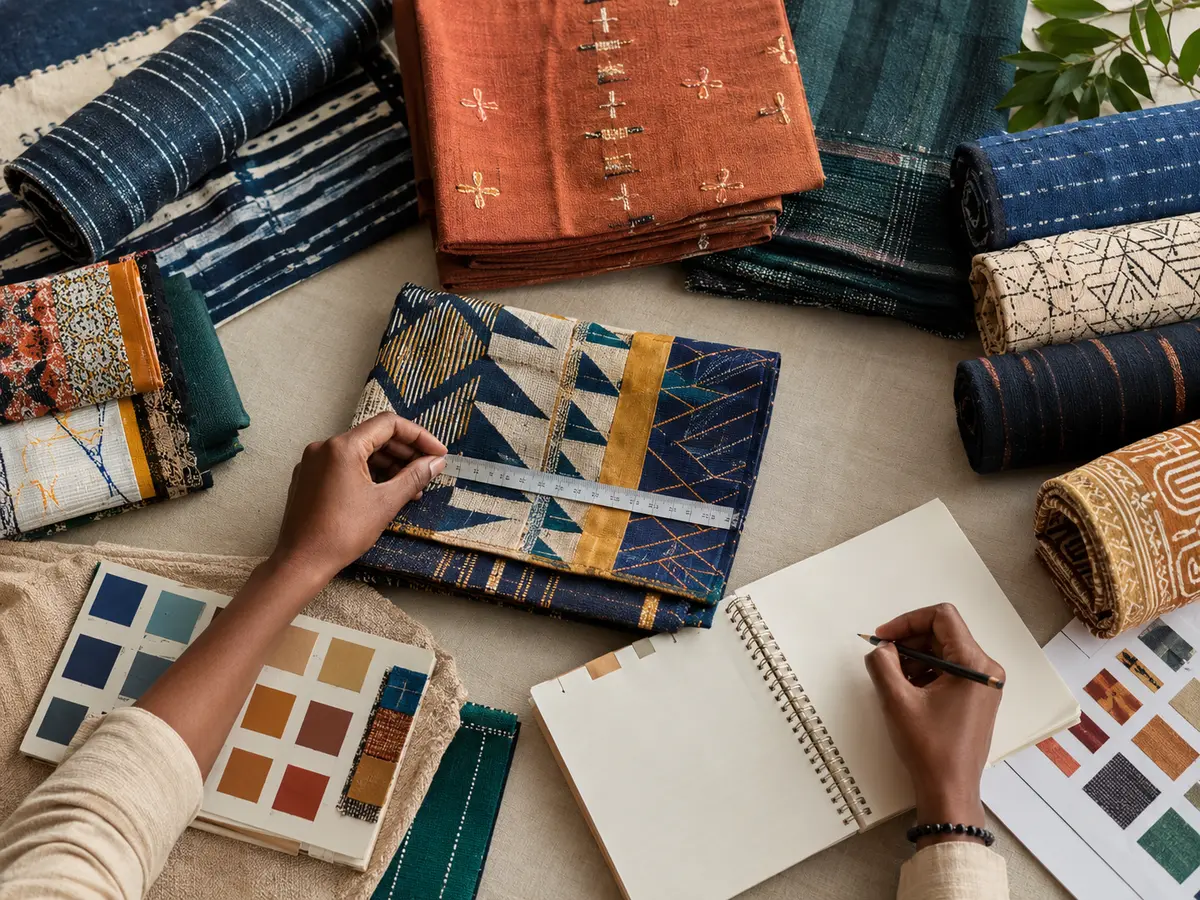
Wholesale African fabrics can give a fashion brand distinctive colour, cultural depth and strong merchandising potential—but a successful bulk order depends on more than choosing an attractive print. Buyers need to confirm fibre content, usable width, colour consistency, repeat size, shrinkage, order units, replenishment options and delivery terms before committing capital.
This guide explains how designers, boutiques, uniform suppliers and growing clothing brands can source African textiles with fewer surprises. It applies whether you are buying fabric for resale, ordering material for your own workshop or preparing for managed garment production.
What does buying African fabric wholesale mean?
Wholesale buying means purchasing fabric in larger quantities or trade units at terms intended for business use. Depending on the textile and supplier, the order unit may be a yard, metre, six-yard cut, full piece, roll, bundle, carton or mixed assortment. “Wholesale” does not describe one universal quantity, discount or quality grade.
That distinction matters. A low minimum order value can suit a boutique testing several prints, while a production brand may need repeatable yardage from one dye lot. A retailer may prioritise variety; a manufacturer may prioritise continuity, test results and exact specifications.
Wholesale African fabrics: choose the buying model first
Start with the commercial outcome, then select the sourcing model that supports it.
| Buying model | Best for | Main advantage | Main risk to manage |
|---|---|---|---|
| Mixed small wholesale order | Boutiques, resellers and market testing | More design variety with less exposure per print | Limited replenishment or inconsistent specifications |
| Bulk order of stocked fabric | Established sellers and production runs | Faster access when inventory is available | Stock may sell through before repeat orders |
| Made-to-order or custom print | Brands, uniforms, events and exclusive collections | Greater control over artwork, colour and exclusivity | Development costs, higher minimums and longer timelines |
| Fabric plus managed production | Brands wanting finished garments | Fabric decisions are coordinated with sampling and manufacturing | More approvals, technical documentation and quality-control stages |
At Oulapeh, wholesale fabric supply, individual customisation and managed garment production are treated as related but distinct services. Availability, minimum order quantity, price and lead time should be confirmed for each quotation rather than assumed.
Define your fabric specification before requesting prices
A useful quotation request is specific enough for suppliers to compare like with like. “I need Ankara” is a starting point, not a complete specification.
1. Fibre composition
Ask whether the fabric is cotton, a cotton blend, silk, rayon, polyester, wool or another fibre. Fibre content affects feel, drape, breathability, pressing, shrinkage, care and labelling obligations. If you will sell finished products in the United States, the Federal Trade Commission requires most textile products to disclose fibre content, country of origin and the identity of the responsible business. Requirements differ by market, so confirm the rules in every destination country.
2. Construction and weight
“African fabric” describes a broad commercial and cultural category, not a single construction. Confirm whether the material is woven, knitted, embroidered or printed, and request weight in grams per square metre where available. Also ask about weave structure, opacity, stretch and intended end use.
3. Width and usable width
Nominal width and usable width are not always identical. Selvedges, embroidery borders or printing irregularities may reduce the cutting area. Your marker and consumption calculation should use the width available for actual garment pieces.
4. Print repeat and motif direction
Large motifs, borders and one-way prints can increase fabric consumption because pattern pieces must be positioned carefully. Request repeat dimensions and clear photographs or a physical sample before finalising a garment costing.
5. Colour and finish
Screen appearance is not a reliable colour standard. Ask for physical swatches, a recognised colour reference where relevant, and confirmation of finishes such as wax, resin, metallic foil, embroidery, sequins or special coatings. Note that care and pressing methods may change when decorative finishes are present.
Match the textile to the end product
The right choice depends on the wearer, silhouette, construction and care expectations. Use the following as a planning framework rather than a substitute for sampling.
| End use | Useful properties to assess | Questions to ask |
|---|---|---|
| Dresses, shirts and separates | Drape, breathability, opacity, shrinkage | Does the hand suit the silhouette? Is lining required? |
| Structured jackets and bags | Body, abrasion resistance, fusing compatibility | Will interfacing change the surface or finish? |
| Children’s clothing | Comfort, washability, trim security, compliance | Are the fabric and components suitable for the target age and market? |
| Uniforms and group orders | Colour continuity, replenishment, durability | Can matching fabric be supplied across all required batches? |
| Occasionwear | Embroidery quality, embellishment security, width | How should the fabric be cut, pressed, cleaned and stored? |
| Home and event décor | Width, lightfastness, flame-performance needs | Does the intended venue or market impose specific safety standards? |
For an overview of textile families and their typical characteristics, see our guide to types of African fabrics. Buyers can also review the planned fabric collection or begin with an African textile sourcing request.
Order samples before committing to bulk
A sample-first process reduces avoidable uncertainty. The sample should represent the material you expect to receive, but buyers should still ask whether bulk goods will come from the same production lot.
Evaluate the sample under conditions relevant to the final product:
- compare colour in daylight and controlled indoor light;
- measure width, weight and visible repeat;
- inspect both faces, selvedges and decorative elements;
- test sewing, pressing, fusing and seam performance;
- wash or clean it using the intended care method;
- measure dimensional change after conditioning;
- check colour transfer, rubbing and wash performance where relevant;
- make a prototype garment before approving production.
For larger or regulated programmes, agree which laboratory tests, methods and acceptance tolerances apply. International standards organisations publish test methods for textile properties, but the correct test plan depends on the product and sales market.
Calculate quantity with a realistic allowance
Begin with approved marker consumption or a tested per-unit estimate. Multiply it by the planned quantity, then account for matching, cutting loss, defects, sampling, replacements and future repairs.
Planning formula: required fabric = unit consumption × production quantity + approved allowance.
For example, if a style consumes 2.2 metres and the order is 100 units, the base requirement is 220 metres. The appropriate allowance is not universal: a plain fabric, engineered border, large repeat and hand-produced textile may each require a different approach. Confirm the allowance with the pattern cutter, production team and supplier before ordering.
Also decide whether you need reserve stock. Reordering later may produce a shade variation or encounter discontinued inventory, so repeat programmes need a documented replenishment plan.
Understand what changes a wholesale quotation
Price is affected by more than volume. A responsible quotation may reflect fibre, construction, width, finish, origin, brand, design complexity, stock position, order mix, testing, packaging, custom development, freight, duties and payment terms.
Ask suppliers to state:
- currency and price unit;
- minimum quantity or minimum order value;
- whether taxes, freight and duties are included;
- sample and custom-development charges;
- packaging and labelling assumptions;
- quotation validity;
- payment schedule;
- estimated dispatch window and its dependencies.
Avoid comparing a price per yard with a price per metre, or a six-yard cut with a full piece, without converting the units. Also separate fabric cost from landed cost: the lowest ex-supplier price is not necessarily the lowest delivered cost.
Use a clear supplier and quality checklist
Before paying a deposit or placing a large order, document the commercial and technical agreement.
- Verify the supplier and contact details. Confirm the legal or trading identity, payment destination and order contact.
- Approve a written specification. Include composition, construction, width, colour, design, finish, quantity and packing.
- Record the approved sample. Date or code it so both parties know which reference governs the order.
- Agree tolerances and inspection. Define what will be checked, when it will be checked and how nonconforming goods will be handled.
- Confirm logistics terms. State origin, destination, shipping method, responsibilities, documentation and insurance arrangements.
- Protect artwork and exclusivity. For custom prints, specify ownership, permitted use, confidentiality and any exclusivity period in writing.
- Keep an approval trail. Save quotations, invoices, sample approvals, colour comments, test reports and shipping documents.
Plan international shipping and import requirements
Cross-border orders may require a commercial invoice, packing list, transport document, accurate product description, customs classification, origin information and other market-specific documents. Duties, taxes and import controls vary by product and destination.
Decide who is responsible for freight, clearance, duties, insurance and delivery. Incoterms published by the International Chamber of Commerce can help businesses define delivery responsibilities, but the selected rule must be named precisely in the contract. Work with a qualified customs broker or freight professional for destination-specific advice.
If you intend to resell fabric or finished clothing, confirm textile labelling, product safety, packaging and consumer requirements before shipment—not after goods arrive.
When should you move from fabric sourcing to garment production?
Fabric-only wholesale is suitable when you already have dependable pattern cutting, sampling, production and quality-control capacity. Managed production may be more efficient when you need those stages coordinated around one specification.
A typical development path is:
- share the product brief and target market;
- select or source suitable fabric;
- prepare patterns and a technical pack;
- develop and fit a sample;
- confirm costing, quantity and production plan;
- approve a pre-production reference;
- manufacture with agreed quality checkpoints;
- inspect, pack and prepare dispatch.
Oulapeh supports individual customisation as well as quote-based bulk and private-label enquiries through managed production partners. No production quantity, timeline or capability should be assumed until the project has been reviewed. Explore garment production services, learn about private-label clothing, or submit a request for quotation.
Wholesale African fabric buying checklist
- Define the product, market and required delivery date.
- Specify fibre, construction, weight, width, colour, finish and repeat.
- State the order unit and total quantity clearly.
- Request representative samples and test them for the intended use.
- Calculate consumption from an approved pattern or marker.
- Agree tolerances, inspection stages and remedies.
- Confirm pricing basis, payment terms and quotation validity.
- Plan packaging, shipping, customs and product compliance.
- Document custom artwork rights and confidentiality.
- Keep reserve material when shade continuity or repairs matter.
Frequently asked questions
What is the minimum order for wholesale African fabrics?
There is no universal minimum. It may be based on order value, yards or metres, pieces, rolls, bundles, cartons, one design or a mixed assortment. Request the exact minimum for the selected material and colour.
Can I order a custom African print?
Custom printing may be possible depending on artwork, print method, substrate, colour requirements and quantity. Expect an artwork review, sampling or strike-off approval, commercial quotation and a longer development process than stocked fabric.
Should I buy by the yard, metre, piece or roll?
Use the unit that matches the supplier’s inventory and your production calculation, but convert everything to one unit before comparing quotations. Confirm the actual length and usable width of every piece or roll.
How can I reduce colour variation in a bulk order?
Order the required quantity together where practical, request goods from one production lot, approve a physical colour reference and define an acceptable tolerance. Reserve extra material for repeat orders or repairs when consistency is critical.
Can Oulapeh supply fabric and make the garments?
Oulapeh accepts enquiries for fabric sourcing, individual customisation and managed garment production. Feasibility, quantity, price, lead time and production route are confirmed after reviewing the project brief and sample requirements.
Source better with a quotation built around your project
A good wholesale order begins with a precise brief. Tell Oulapeh what you are making, the textile or look you need, your estimated quantity, destination and target timing. The team can then review the appropriate sourcing or production route without making assumptions about minimums or capability.
Request wholesale pricing and sample options for your next collection, retail order, uniform programme or custom project.
Editorial note: This guide provides general sourcing information, not legal, customs or product-compliance advice. Requirements vary by product and destination. Authoritative references include the U.S. Federal Trade Commission’s textile guidance, the International Chamber of Commerce’s Incoterms resources and the International Organization for Standardization’s textile standards catalogue. Reviewed 23 August 2026.

Add comment